Finders Keepers
Turning "Do You Have One of These?" into a Business Opportunity
A Bonn Technologies Case Study
Every antiques dealer knows the question.
A customer walks into the shop looking for something particular. Perhaps it's a replacement piece for a grandmother's china service, an obscure automotive collectible, a certain piece of mid-century furniture, or an object remembered from childhood.
The dealer doesn't have it.
The customer leaves, and with them goes a potential sale.
Yet somewhere, perhaps across town or across the country, another dealer may have exactly what the customer wants.
The problem isn't necessarily that the object can't be found. It's that the person looking for it and the person selling it have no practical way to find each other.
That was the idea behind Finders Keepers.
An Old Problem, a New Approach
The antiques and vintage trade is wonderfully fragmented. Dealers specialize in different objects, work from different locations, and maintain inventories that change constantly.
This diversity makes the trade interesting, but it also creates a problem: no single dealer can stock everything, and no customer can visit every shop.
Traditional wanted advertisements have existed for generations. Collectors place notices, dealers keep lists, and people ask around. Sometimes the system works. Often, the request is forgotten long before the desired object appears.
We wondered whether the familiar wanted advertisement could become something more useful.
What if a dealer could record a customer's request in seconds? What if that request could be compared automatically against participating dealers' inventories? And what if the system could continue looking as new merchandise arrived?
Finders Keepers grew from those questions.
Making It Simple
The concept starts in the antiques shop.
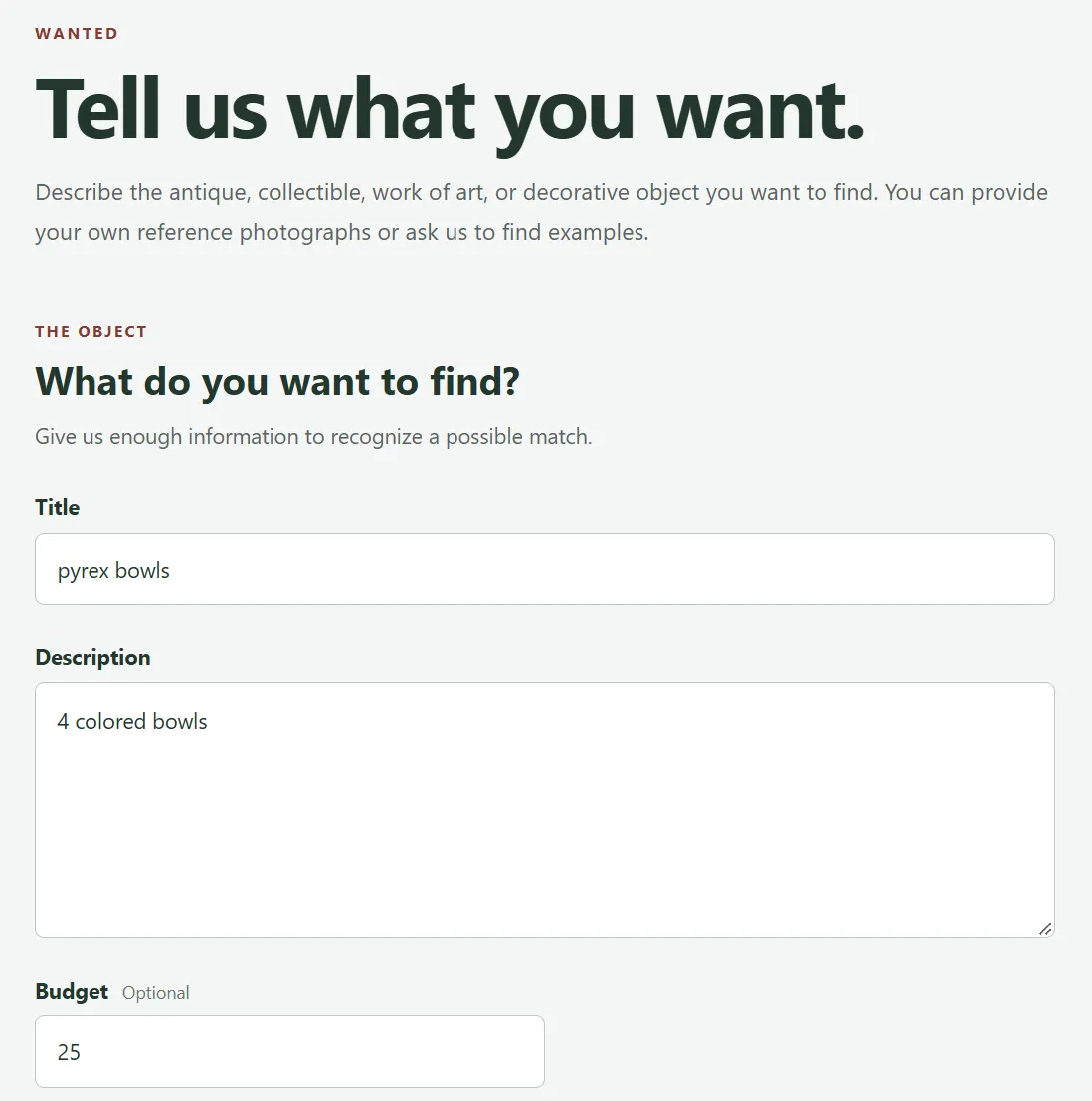
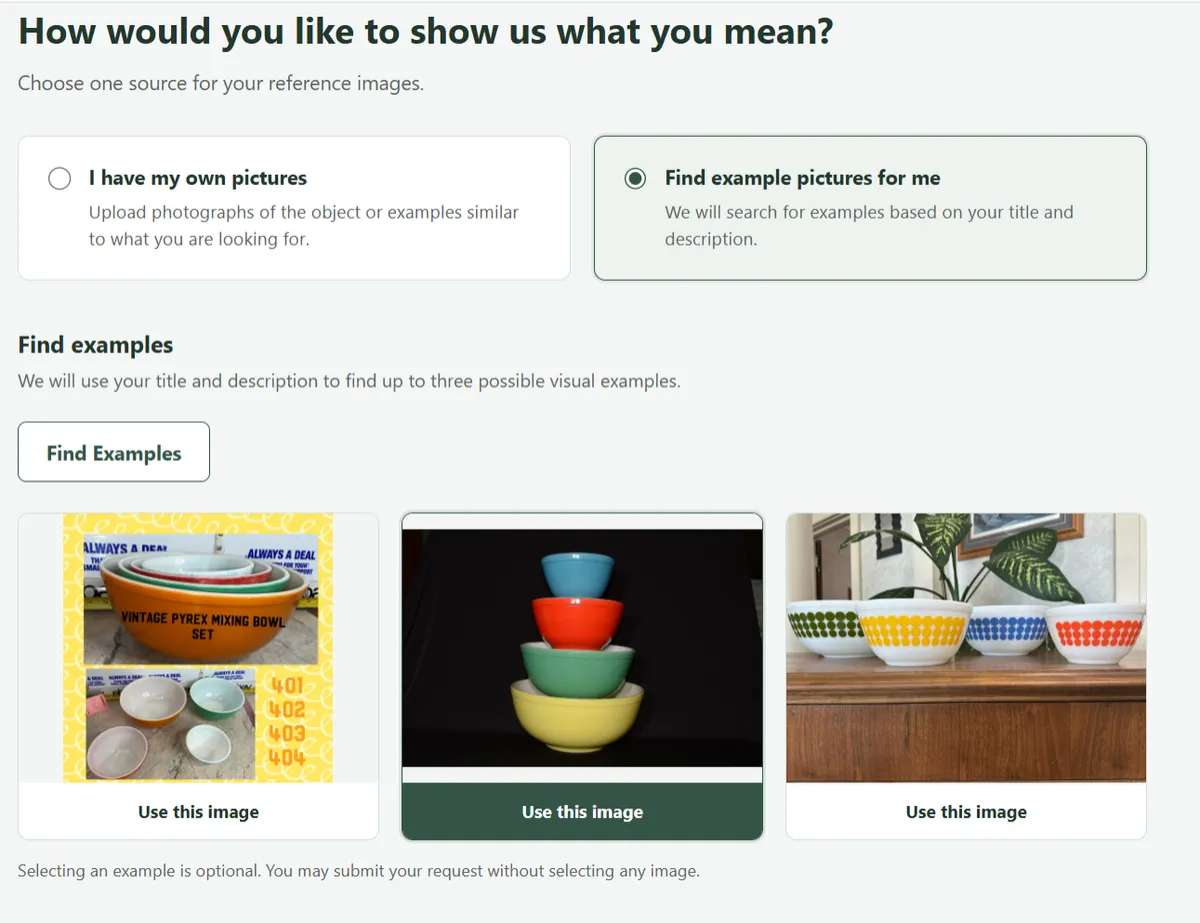
A customer looking for a particular object scans a QR code displayed by the dealer. A short form allows the customer to describe what they're seeking, with the option to include a photograph.
The customer doesn't need to understand databases, search algorithms, or artificial intelligence. They simply describe the object they want.
Behind the scenes, Finders Keepers can use AI to help interpret descriptions and identify possible inventory matches.
As dealers add merchandise, the system can revisit existing wanted advertisements. A request made weeks or months earlier may suddenly become relevant.
And when a promising match appears, the system can bring the interested parties together.
The objective isn't to replace the dealer. It's to give the dealer another way to serve customers and find business that might otherwise have been lost.
Designed Around the Way Dealers Work
A particularly important consideration was the relationship between the customer and the dealer who originated the request.
If a dealer introduces a customer to Finders Keepers, that relationship should be respected.
The system is designed to preserve the originating dealer's opportunity while also allowing broader matching when appropriate.
Before an introduction is made, the participating dealer can confirm that the item is available and appears to meet the request. The interested customer can then confirm whether they wish to proceed.
The technology facilitates the connection. The people conduct the business.
For independent dealers and antiques malls, this creates an opportunity to collaborate without giving up their individual identities or customer relationships.
Why Build It in the Cloud?
Finders Keepers needs to be available wherever dealers and collectors happen to be.
A customer might submit a request from a shop in Georgia. A dealer might add matching inventory from an antiques show in another state. The two activities could take place months apart.
A cloud-based application makes that possible without requiring participating businesses to install software, maintain servers, or manage technical infrastructure.
The system is designed around several cooperating capabilities:
- A shared online service where wanted advertisements and participating inventories can be maintained.
- Artificial intelligence to help interpret item descriptions and identify potential matches.
- Automated processing to check new requests and newly added inventory.
- Notifications and introductions to bring interested parties together when a possible match is confirmed.
Each component serves a practical purpose. Together, they allow a relatively small business concept to operate across a potentially large network of participants.
And because the application is cloud-native, its capabilities can be extended without requiring every dealer to change the way they work.
More Than a Wanted Ad
The interesting thing about Finders Keepers is that it begins with something very ordinary: a customer asking a question.
But answering that question at scale requires several activities to work together.
Information must be collected, interpreted, stored, searched, compared, and acted upon. Relationships between customers and dealers must be maintained. New inventory must be considered against previous requests.
These are tasks that would be cumbersome, if not impossible, to perform manually across a network of independent businesses.
Software makes the connections possible. Automation makes them practical.
And artificial intelligence offers a way to work with the often imprecise language of antiques and collectibles, where an object might be described by its appearance, age, use, maker, or simply a customer's memory.
The Bonn Technologies Approach
Finders Keepers illustrates the kind of problem we enjoy solving.
The starting point wasn't a technology looking for a purpose. It was a recognizable business problem in an industry we know.
From there, the work involved understanding how people actually conduct business, identifying where technology could make a difference, and designing a service that accommodates the realities of the trade.
Not every business needs a custom application of this scope. Sometimes an existing product, a small integration, or a straightforward automation is the better answer.
But when a business has a distinctive opportunity that existing software cannot adequately address, custom development can turn that idea into something practical.
The best technology is often the technology that lets people do something useful without having to think about the technology at all.
Have an Idea of Your Own?
Perhaps you've noticed a recurring problem in your business. Perhaps you have an idea for a service, but aren't sure how to make it work.
That's a good place to start.
Tell Bonn Technologies what you have in mind. We'll help you explore what's possible.
Let's Talk